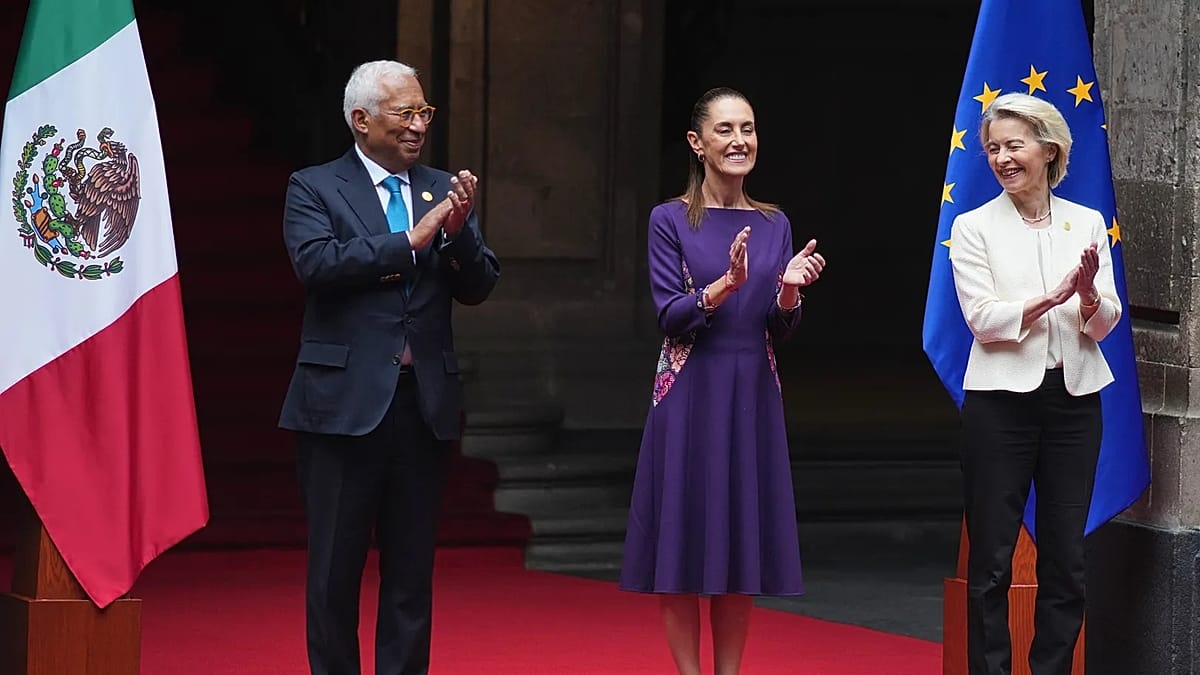
EU Mexico Trade Deal - highlights market-moving developments and broader financial market activity. European Union leaders signed an updated trade agreement with Mexico on Friday, replacing the original deal from two decades ago. The pact aims to strengthen economic ties and reduce both parties' dependence on the United States and China amid rising geopolitical tensions.
Live News
EU Mexico Trade Deal - highlights market-moving developments and broader financial market activity. Real-time monitoring allows investors to identify anomalies quickly. Unusual price movements or volumes can indicate opportunities or risks before they become apparent. On Friday, EU Commission President Ursula von der Leyen and European Council President António Costa signed an updated trade deal with Mexico, marking the first major revision of the agreement since its original signing two decades ago. The new pact is designed to deepen economic cooperation between the EU and Mexico, one of Latin America's largest economies. According to the European Commission, the updated agreement will eliminate tariffs on nearly all goods traded between the EU and Mexico, including agricultural products, industrial goods, and services. It also includes provisions on intellectual property, sustainable development, and digital trade. The deal is seen as a strategic move by both sides to diversify their trade partners and reduce exposure to the U.S. and Chinese markets, which have become increasingly contested amid trade disputes and geopolitical uncertainty. The signing ceremony took place in Brussels, with von der Leyen calling the agreement a "milestone" for EU-Latin American relations. The deal must still be ratified by the European Parliament and all EU member states, as well as by Mexico's Senate, before it can take full effect. However, provisional application of certain trade provisions could begin earlier.
EU and Mexico Sign Updated Trade Deal to Reduce Reliance on US and China Understanding macroeconomic cycles enhances strategic investment decisions. Expansionary periods favor growth sectors, whereas contraction phases often reward defensive allocations. Professional investors align tactical moves with these cycles to optimize returns.Structured analytical approaches improve consistency. By combining historical trends, real-time updates, and predictive models, investors gain a comprehensive perspective.EU and Mexico Sign Updated Trade Deal to Reduce Reliance on US and China Real-time analytics can improve intraday trading performance, allowing traders to identify breakout points, trend reversals, and momentum shifts. Using live feeds in combination with historical context ensures that decisions are both informed and timely.Combining technical analysis with market data provides a multi-dimensional view. Some traders use trend lines, moving averages, and volume alongside commodity and currency indicators to validate potential trade setups.
Key Highlights
EU Mexico Trade Deal - highlights market-moving developments and broader financial market activity. Sentiment shifts can precede observable price changes. Tracking investor optimism, market chatter, and sentiment indices allows professionals to anticipate moves and position portfolios advantageously ahead of the broader market. Key takeaways from the deal include a potential boost for EU exports of machinery, pharmaceuticals, and vehicles to Mexico, while Mexican agricultural products such as avocados, tequila, and berries would likely gain easier access to European consumers. The agreement may also encourage more European investment in Mexico's renewable energy, infrastructure, and digital sectors. From a sectoral perspective, European automakers and chemical companies could benefit from reduced tariffs and harmonized standards. Conversely, some European agricultural producers might face increased competition from Mexican imports. The deal also includes stronger labor and environmental commitments, which could affect supply chain practices. For the EU, this agreement reinforces its foothold in Latin America, a region where China has rapidly expanded trade and investment in recent years. Mexico stands to gain as a manufacturing hub with privileged access to both the EU and the United States via the USMCA trade pact, potentially attracting more foreign companies seeking diversified supply chains.
EU and Mexico Sign Updated Trade Deal to Reduce Reliance on US and China Investors often test different approaches before settling on a strategy. Continuous learning is part of the process.Real-time updates are particularly valuable during periods of high volatility. They allow traders to adjust strategies quickly as new information becomes available.EU and Mexico Sign Updated Trade Deal to Reduce Reliance on US and China Real-time data supports informed decision-making, but interpretation determines outcomes. Skilled investors apply judgment alongside numbers.Data-driven insights are most useful when paired with experience. Skilled investors interpret numbers in context, rather than following them blindly.
Expert Insights
EU Mexico Trade Deal - highlights market-moving developments and broader financial market activity. Monitoring the spread between related markets can reveal potential arbitrage opportunities. For instance, discrepancies between futures contracts and underlying indices often signal temporary mispricing, which can be leveraged with proper risk management and execution discipline. From an investment perspective, the updated EU-Mexico trade deal could signal a broader trend of regional bloc realignment as global trade tensions persist. Investors might view the agreement as a positive step for companies with cross-border exposure in Europe and Latin America, though the full impact would depend on ratification timelines and implementation details. The deal also highlights the growing importance of Latin America as a middle ground amid U.S.-China rivalry. For multinational corporations, the pact may offer a more predictable regulatory environment for trade and investment. However, risks remain, including potential delays in ratification, political changes in either region, and the possibility of future trade disputes. While the agreement does not guarantee immediate economic gains, it establishes a framework that could reduce trade friction and support long-term business planning. Market participants would likely monitor subsequent developments, including any adjustments to rules of origin and dispute resolution mechanisms. Disclaimer: This analysis is for informational purposes only and does not constitute investment advice.
EU and Mexico Sign Updated Trade Deal to Reduce Reliance on US and China Analytical platforms increasingly offer customization options. Investors can filter data, set alerts, and create dashboards that align with their strategy and risk appetite.Scenario analysis based on historical volatility informs strategy adjustments. Traders can anticipate potential drawdowns and gains.EU and Mexico Sign Updated Trade Deal to Reduce Reliance on US and China While algorithms and AI tools are increasingly prevalent, human oversight remains essential. Automated models may fail to capture subtle nuances in sentiment, policy shifts, or unexpected events. Integrating data-driven insights with experienced judgment produces more reliable outcomes.Investors often experiment with different analytical methods before finding the approach that suits them best. What works for one trader may not work for another, highlighting the importance of personalization in strategy design.